4 min read
4 Key Criteria for Determining the Research Design of Your Thesis
In our last session, we defined the “WHAT” of your research through the holotypes or types of research. Now it is time to define the “HOW”: the strategy you will use to find the answers. Welcome to the world of research design.
Understanding this concept is essential to the validity of your thesis. And the first thing to clarify is a fundamental point: research design is not the same as the type of research.
- The Type (Holotype) is defined by your general objective. It is the level of knowledge you aim to reach (to describe, explain, propose, etc.).
- The Design is defined by your procedure. It is the strategic plan you will follow to collect your data in a valid and reliable way.
How Do I Identify My Thesis Design? The 4 Key Criteria
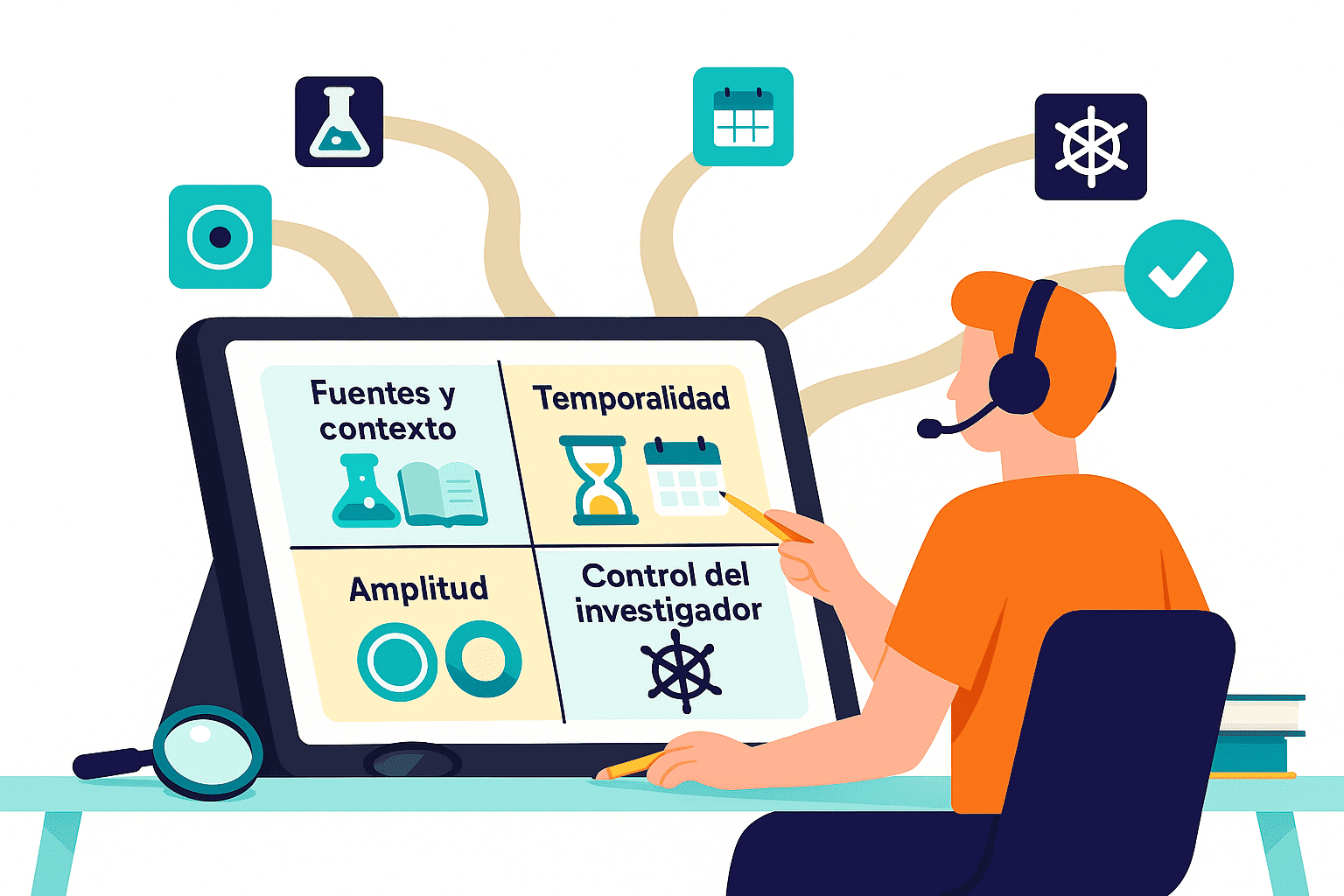
Choosing a design is not about picking a name from a list at random. It is the result of making strategic decisions based on four methodological criteria. Think of it as setting up the GPS for your data collection.
1. Where Does Your Data Come From? (Sources and Context)
- Field design: When you gather information from living sources (people, groups) in their natural setting. It is the most common in the social sciences.
- Laboratory design: When you collect data in an artificial or controlled environment that you create.
- Documentary design: When your sources are documents (books, articles, photos, archives, videos). Be careful! It is not just about reading; it is about analyzing those documents to generate new knowledge.
- Mixed-source design: When you combine living and documentary sources.
2. When Will You Collect the Data? (Temporality)
- Cross-sectional (or synchronic) designs: When you study an event at a single point in time, like a photograph.
- Longitudinal designs: When you study an event over time, like a film, to reconstruct its evolution.
- Retrospective: When the film has already played out and you look toward the past.
- Contemporary: When you record the film as it unfolds in your present.
3. How Broad Is Your Focus? (Scope)
- Single-event designs: When you focus on a single event or main variable.
- Multiple-event designs: When you consider multiple events of study or variables.
4. Do You Intervene or Only Observe? (Researcher Control)
This criterion applies mainly if your holotype is integrative (interactive, confirmatory, or evaluative).
- Non-experimental design: You do not manipulate any variable; you simply observe and analyze what already exists. Most field and documentary designs fall into this category.
- Ex post facto design: You study the effects of something that already happened without your intervention (for example, the impact of a law that has already been implemented).
- Quasi-experimental design: You apply an intervention (a workshop, a program), but you do not have full control over all the variables (e.g., you cannot assign participants at random).
- Experimental design: You have maximum control. You manipulate variables, randomly assign subjects to groups (control and experimental), and seek to establish cause-and-effect relationships.
Overwhelmed by the Options? Tutoeris Helps You Define Your Design
Choosing the right combination of these criteria can be complex. A mistake here can affect the validity of your thesis. This is where the methodological guidance of Tutoeris’s artificial intelligence becomes indispensable.
In Tutoeris’s Project Hub, after defining your holopraxic statement and your holotype, the platform guides you through the Methodological Framework section. It does not leave you on your own; instead, it asks you the key questions:
- “Will your main source of data be documents or people in their natural setting?”
- “Will you collect the data at a single point in time or over a period in order to observe its evolution?”
- “Does your research involve manipulating some situation, or will you only observe what already exists?”
Based on your answers, Tutoeris’s artificial intelligence not only suggests the right combination but also helps you draft the formal statement for your thesis. At the end of the process, the platform will present you with a clear statement such as:
“This study is framed within a field, cross-sectional, and multiple-event design.”
This gives you the correct terminology, ensures the coherence of your research methodology, and gives you the confidence to move forward.
Conclusion
Research design is your action plan for gathering evidence rigorously. By understanding these four criteria, you stop guessing and take control of your methodology. It is the difference between an erratic journey and a well-planned expedition that will lead you to valid and reliable results in your thesis.