11 min read
Methodological Coherence: When Your Thesis Speaks With a Single Voice

There is a kind of problem in theses that goes unnoticed until the day of the defense. It is not an isolated mistake, not a poorly worded citation or a wrong piece of data. It is something deeper: a misalignment among the pieces of the methodological design that keeps the research from working as an integrated whole.
The general objective says “to describe,” but the holopraxic statement asks about causes. Or the theoretical framework supports an explanatory study, yet the design is cross-sectional and non-experimental. Or the conclusions answer questions that the specific objectives never raised.
That is a lack of methodological coherence. And in the holistic understanding of science, developed by Dr. Jacqueline Hurtado de Barrera, this coherence is not a vague ideal: it has a precise structure, it can be verified before moving forward, and there are concrete tools to diagnose and correct it.
What Methodological Coherence Means in the Holistic Understanding of Science
Within the holistic understanding of science, methodological coherence is the congruence among all the components of the research process: the holopraxic statement, the level of depth, the research holotype, the objectives, the design, the data-collection techniques, the analysis techniques, and the conclusions.
Hurtado de Barrera describes a coherent study as one in which each component can be derived from the others. If you know the holopraxic statement, you can deduce the general objective. If you know the objective, you can identify the holotype. If you know the holotype, you can determine the type of design, the appropriate techniques, and the type of result that will be obtained. That is the logic of the research hologram: from any single piece, the whole should be visible.
The opposite—the lack of congruence—produces what the author calls methodological inconsistencies: a design that is incongruent with the type of research, a type of research that is incongruent with the objectives, objectives that are incongruent with the conclusions. Each inconsistency carries over and is amplified in the later phases.
The Research Hologram: Coherence Made Visible
The research hologram is a visual tool proposed by Hurtado de Barrera to represent the entirety of the study from just one of its components. Its name comes from holography: just as a hologram contains the complete image of the object within each of its fragments, in a coherent study each component contains enough information to deduce the others.
Here is how it works in practice: you take the holopraxic statement and, from it, derive a chain:
- The level of depth — how deep is the knowledge I aim to produce?
- The research holotype — what type of result am I going to generate?
- The general objective — what is the verb that describes that result?
- The specific objectives — what intermediate steps do I need to cover?
- The units of study and the population — on whom or what will the analysis fall?
- The research design — how am I going to collect the data?
- The techniques and instruments — with what am I going to collect them?
- The analysis techniques — how am I going to process the information?
- The type of conclusions — what form will my final results take?
If at any of those steps the derivation does not work—if the chosen design does not correspond to the holotype, or the analysis techniques are not suited to the type of data that will be obtained—there is an inconsistency. The hologram makes it visible before it is too late.
The Four Levels of Depth and Their Holotypes
The holistic understanding of science organizes the ten research holotypes into four levels of depth that range from lower to higher complexity. Understanding these levels is essential for coherence, because the level determines the holotype, which determines the objective, which determines the verb, which determines the design.
These are the four levels according to Hurtado de Barrera (2010):
| Level | Holotype | Guiding Question | Verb of the Objective |
|---|---|---|---|
| Perceptual | Exploratory | What is in the context? What can be asked about the event? | Explore, inquire, discover |
| Perceptual | Descriptive | What is the event like? What are its characteristics? | Describe, characterize, classify, diagnose |
| Apprehensive | Analytical | To what extent does the event fit a criterion? What judgment does it deserve? | Analyze, interpret, critique, judge, assess |
| Apprehensive | Comparative | How do two or more groups differ from or resemble one another with respect to the event? | Compare, contrast, differentiate, collate |
| Comprehensive | Explanatory | Why does the event occur? What are its causes? | Explain, identify causes, theorize |
| Comprehensive | Predictive | How will the event manifest in the future if certain conditions are met? | Predict, estimate trends, anticipate scenarios |
| Comprehensive | Projective | What proposal or design will solve the identified problem? | Propose, design, formulate, create |
| Integrative | Interactive | What changes does the intervention generate on the event under study? | Modify, intervene, apply and evaluate the process |
| Integrative | Confirmatory | Is the hypothesis derived from the explanatory theory verified? | Confirm, verify, test, contrast |
| Integrative | Evaluative | To what extent did the program or intervention achieve its objectives? | Evaluate, estimate impact, estimate effectiveness |
The level of depth is not a free choice: it is determined by the state of knowledge on the topic and by the research purpose. If descriptions and prior analyses of the event under study already exist, you can start from a comprehensive level. If they do not exist, you must begin at the perceptual level.
The Holistic Spiral: Why You Cannot Skip Levels
One of the most important principles for methodological coherence is what Hurtado de Barrera calls the holistic spiral: each holotype at a higher level requires as its starting point the results of the previous level. Not out of methodological whim, but for a logical reason: you cannot explain what has not yet been described, nor predict what has not been explained, nor confirm a hypothesis without an explanatory theory to support it.
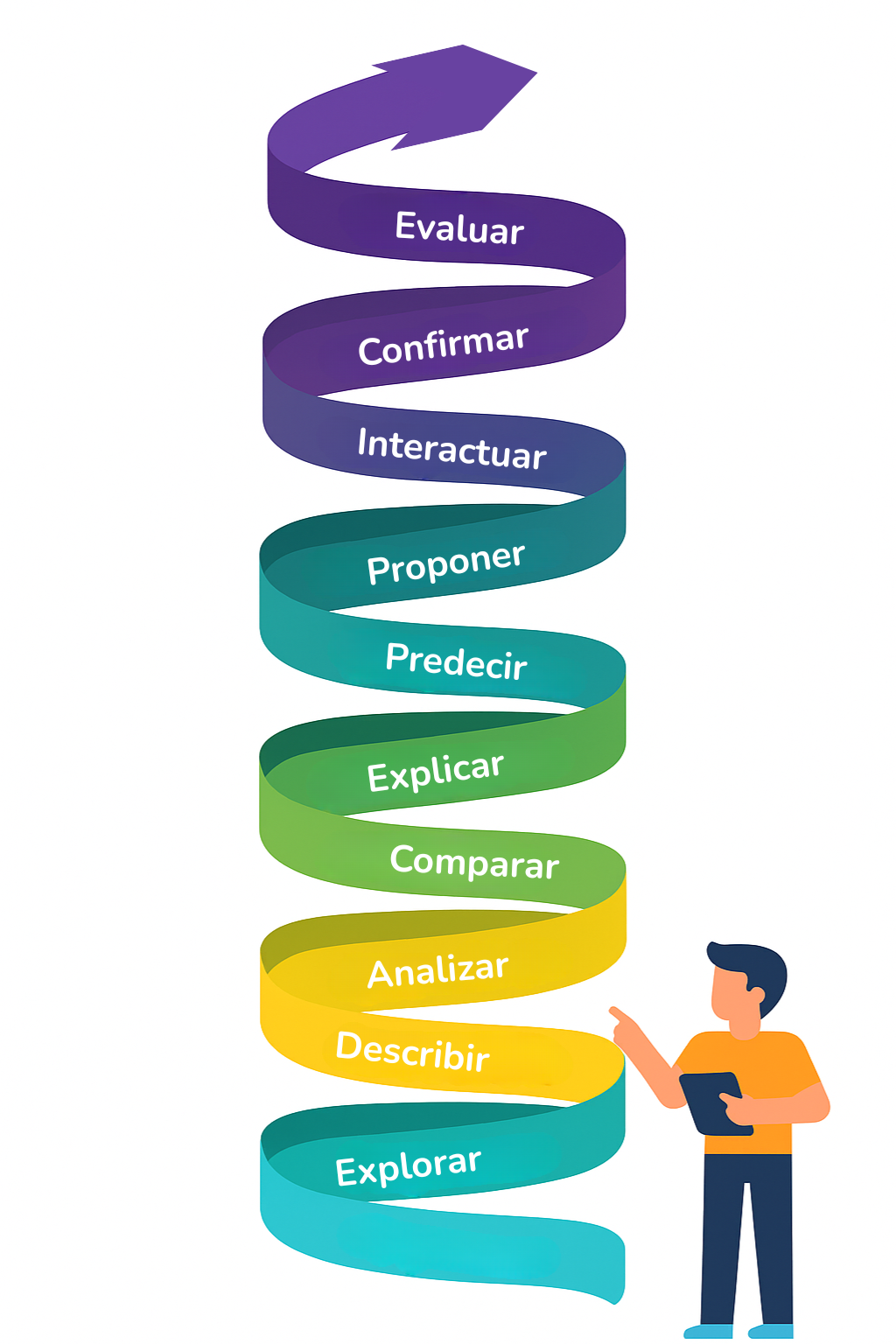
In practical terms, this means:
- An explanatory study requires that descriptions and analyses of the event already exist (in the literature or as earlier stages of the same study).
- A projective study requires that the causes of the problem to be solved have already been identified—otherwise, the proposal lacks any foundation.
- A confirmatory study requires a hypothesis derived from an already existing explanatory theory. You cannot confirm what no theory has explained.
- An evaluative study requires that the intervention has already been applied, and that effectiveness criteria have been defined beforehand.
The mistake of skipping levels is one of the most frequent in master’s and doctoral theses: researchers who propose a projective study without evidence of having gone through the explanatory phase, or who declare a confirmatory study without having a theory to support their hypothesis.
The solution is not always to redo all the work. Sometimes it is enough to reaffirm the holotype at the correct level according to the real conditions of the study, or to incorporate the explicit acknowledgment of the prior research that covers the earlier stages.
The Chain of Coherence: From the Question to the Conclusions
Methodological coherence is not an abstract property: it is a concrete chain of correspondences among components. If just one of those correspondences breaks, the chain loses its function.
This is the complete chain, with the most frequent breaking points at each link:
Holopraxic Statement → Level → Holotype
The interrogative used in the statement determines the level and the holotype. “To what extent does X fit [criterion]?” is analytical. “Why does X occur?” is explanatory. “What proposal would allow X to be solved?” is projective. If the interrogative does not correspond to the declared holotype, there is an inconsistency from the very outset.
Holotype → Verb of the General Objective
The holotype determines the verb. A descriptive study cannot have “to explain” or “to design” as its objective. An analytical study uses verbs such as analyze, interpret, judge, assess. An explanatory study uses explain, identify causes, theorize. A projective study uses propose, design, formulate. The wrong verb changes the type of research, even if the researcher does not intend it.
General Objective → Specific Objectives
The specific objectives are the intermediate stages needed to reach the general objective. A projective study, for example, must include as specific objectives at least a description of the problem, a diagnosis of its causes, and the construction of the criteria for the proposal. If the specific objectives do not cover those stages, the leap to the projective level has no support.
Objectives → Research Design
The design describes how the data will be collected. It cannot contradict the holotype: a confirmatory study requires a design that makes it possible to establish causal relationships (experimental, quasi-experimental). A descriptive study can use cross-sectional designs. An interactive study requires a design that includes the application of an intervention and the tracking of its effects.
Design → Analysis Techniques → Conclusions
The analysis techniques must be congruent with the type of data the design produces and with the result expected according to the holotype. An analytical study does not conclude with statistical frequencies: it concludes with a well-founded judgment about the event in relation to the analysis criterion. An explanatory study concludes with a causal explanation, not with a characterization. Conclusions that are not derived from the stated objectives—however interesting they may be—break the chain.
The Most Frequent Inconsistencies in Theses
In her work, Hurtado de Barrera identifies the patterns of inconsistency that appear most frequently in research projects. These are the most common ones in the context of graduate theses:
1. The Holopraxic Statement Contains Several Different Studies
A question such as “What are the characteristics of leadership in schools, and what proposal would allow it to be improved?” mixes a descriptive holotype (to characterize) with a projective one (to propose). The result is a study with unclear objectives and results, riddled with inconsistencies among its various aspects. The holopraxic statement must be a single one, coherent with a single holotype.
2. The Type of Research Does Not Match the General Objective
This is the inconsistency most often detected by thesis committees: the researcher declares that the study is “descriptive,” but the general objective reads “To design a program for…” To design is projective. The type of research is not decided by the researcher on a whim: it is determined by the verb of the general objective.
3. The Specific Objectives Skip Stages
In a projective study whose specific objectives go directly to the design of the proposal, without describing the problem or analyzing its causes, the final proposal has no methodological foundation. The committee will detect it because there is nothing in the body of the work that justifies the proposal.
4. The Conclusions Answer Questions That Were Never Posed
Sometimes, during the research, interesting findings emerge that the researcher includes in the conclusions, even though they were not among the objectives. That is not an enrichment: it is another inconsistency. The conclusions must be derived directly from the objectives set at the beginning. Whatever is left over goes into the recommendations or the agenda for future research.
What Does This Mean for Your Thesis?
Verifying the methodological coherence of your thesis is not a review you do at the end, once everything is written. It is a verification that must be carried out before moving from one phase to the next, and the research hologram is the tool for doing so.
This is the basic verification exercise:
- Take your holopraxic statement. Does the interrogative you use correspond to the holotype you declare?
- Take your general objective. Does the verb you use belong to the holotype you declare? Review the table of correspondences.
- Take your specific objectives. Do they cover the earlier stages that your holotype requires as a starting point? Is there any level skip without justification?
- Take your research design. Is it congruent with the holotype? Does it allow you to collect the type of data needed to produce the expected result?
- Take your analysis techniques. Do they produce the type of result that corresponds to your holotype: a characterization, a judgment, an explanation, a proposal?
- Take your conclusions. Can each conclusion be linked directly to a specific objective?
If all six answers are congruent, your thesis has methodological coherence. If any of them is not, that is the exact point where you need to make corrections before continuing.