4 min read
Types of Research for Your Thesis: The Definitive Guide to the 10 Holotypes

When you begin a thesis, one of the first and most crucial decisions is to define its “personality”—that is, the type of research you are going to carry out. This choice is not a mere formality; it is the compass that sets the course for your entire journey, from the methodology all the way to the conclusions.
Before we dive in, let’s clear up a common confusion: the type of research is not the same as the research design. The type refers to the outcome and the degree of complexity of the knowledge you are pursuing (the WHAT you achieve), whereas the design refers to the procedure for collecting data (the HOW you do it).
The guiding star: Your general objective
To know what type of research your thesis is, you only need to look at your guiding star: the general objective. This objective, with its verb in the infinitive, reveals the level of depth and the kind of knowledge you aspire to build. “To describe” leads you down a very different path than “To explain” or “To propose.”
According to the methodology of holistic research, there are ten research holotypes. Think of them as the ten broad paths your thesis can take.
The 10 research holotypes
Here we present each holotype, or type of research. Each one represents a stage of knowledge with its own rules and purposes.
- Exploratory Research
- Purpose: To probe, discover, or explore topics that are little known or vaguely defined. It is the starting point when almost nothing has been written. Its outcome is a set of clearer questions for future research.
- Associated verb: To explore.
- Descriptive Research
- Purpose: To detail the properties and characteristics of an event, person, group, or phenomenon. It focuses on “what is it like?” or “what are its characteristics?”.
- Associated verb: To describe.
- Analytical Research
- Purpose: To reinterpret an event by seeking new relationships among its components in order to gain a deeper understanding.
- Associated verb: To analyze.
- Comparative Research
- Purpose: To establish similarities and differences between two or more groups or situations. It does not seek causes; it only compares.
- Associated verb: To compare.
- Explanatory Research
- Purpose: To find the why behind phenomena, seeking cause-and-effect relationships. It is the type of research that aims to build theories.
- Associated verb: To explain.
- Predictive Research
- Purpose: To anticipate future scenarios or forecast how an event will behave, based on trends and prior analyses.
- Associated verb: To predict.
- Projective Research
- Purpose: To develop a proposal, a plan, a program, a model, or a design to solve a practical problem. It is the realm of inventions and solutions.
- Associated verb: To propose (or to design, formulate, create…).
- Interactive Research
- Purpose: To modify an existing situation and observe the changes. It is closely tied to Action Research, where the goal is to transform the reality being studied.
- Associated verb: To modify or To interact.
- Confirmatory Research
- Purpose: To verify whether a hypothesis, derived from an existing theory, holds true in reality. It is the classic hypothesis-testing research.
- Associated verb: To confirm.
- Evaluative Research
- Purpose: To assess the effectiveness of a program, project, or intervention to see whether it met its objectives.
- Associated verb: To evaluate.
Not sure about your type of research (holotype)? Tutoeris helps you
Choosing among these ten holotypes can feel overwhelming. How can you be certain that your verb and your question match the correct type of research?
This is where Tutoeris’s artificial intelligence becomes your methodological advisor.
As you already know, when Tutoeris helps you formulate your holopraxic statement (your research question), it doesn’t just hand you the question. Next to each option the AI suggests, it clearly shows you the corresponding research holotype.
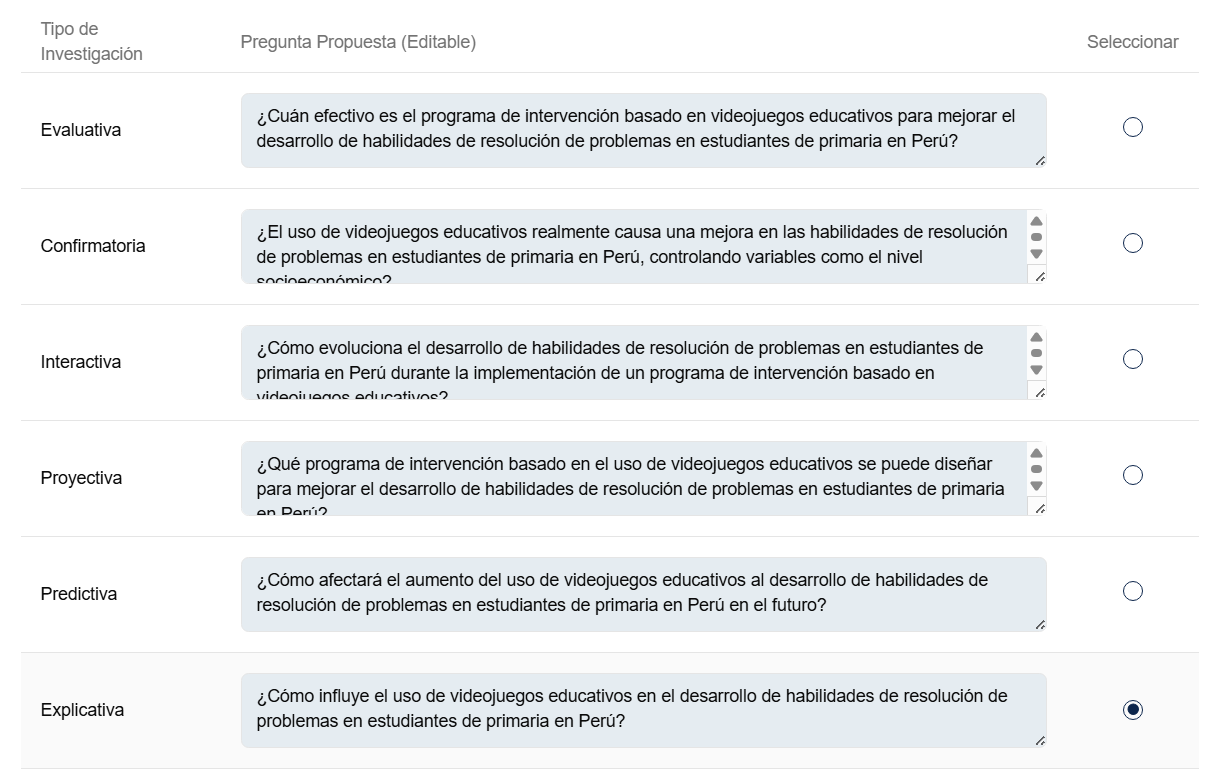
This feature eliminates the guesswork. The moment you select your question, you have already defined with certainty the type of thesis you are going to carry out.
- If you choose a question that begins with “How do… influence?”, Tutoeris will indicate that your holotype is Explanatory.
- If you select “What design could…”, the platform will show you that your holotype is Projective.
In addition, the tool will arrange all the project’s options and settings to fit the selected type of research, so that everything you generate along the way remains methodologically coherent. In this way, artificial intelligence not only speeds up your work but also prevents you from making one of the most common methodological mistakes, ensuring the coherence of your thesis from the very first moment.
Conclusion
Defining the type of research for your thesis means giving your project a clear sense of direction. It is not a label; it is the statement of intent about the level of knowledge you are going to generate. By understanding the ten holotypes and aligning your general objective with one of them, you will have a clear map for each of the following stages of your research.