5 min read
Research Approaches: How to Define Your Methodological Strategy
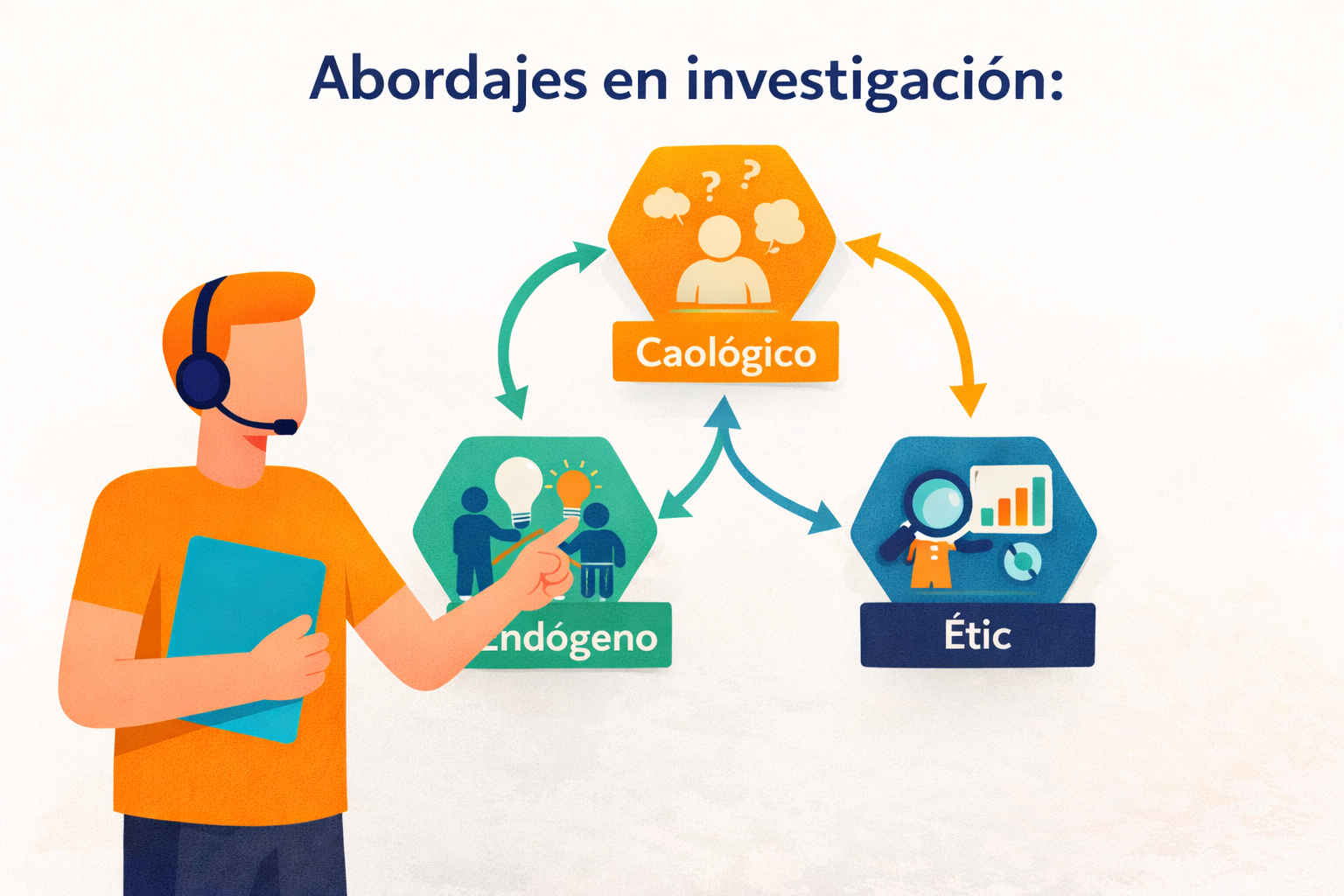
Within the methodological framework of any thesis, there is one component that tends to be overlooked or defined at random: the approach. And yet, it is the decision that determines how you draw near to your event of study. Not what you investigate, but how you confront it.
If the method is the path you travel, the approach is the attitude with which you walk it: whether you go in with open eyes or with a fixed map, whether the route is decided by you or by the community under study, whether you describe what you see from the inside or from the outside.
In the Holistic Understanding of Science, proposed by Dr. Jacqueline Hurtado de Barrera, approaches are not rigid labels. They are complementary criteria that the researcher consciously combines in order to build a methodology coherent with their question.
Where does the word “approach” come from?
Etymologically, it derives from ad (toward, nearness) and borda (the outer side of a vessel). To approach is to move beyond the edge in order to come into contact with the reality we wish to know. This is no ordinary metaphor: the approach implies an intention, a direction, and a manner of drawing near.
This definition matters because it dismantles a common error: assuming that the approach is merely a synonym for a “qualitative perspective” or a “quantitative perspective.” In holistic research, that is neither sufficient nor accurate.
The three criteria of the approach
Holistic methodology defines approaches along three axes that can be combined with one another. None excludes the others.
1. By degree of structuring: chaological vs. cosmological
The chaological approach comes from khaos (open space). It is an approach with minimal prior structuring. The researcher suspends preconceptions and pre-established categories in order to capture what emerges from reality. It is the appropriate approach when the event has not been studied sufficiently, when the culture under investigation is unfamiliar, or when one is searching for emergent categories that do not exist in the literature.
A word of caution: chaological does not mean improvised. It requires meticulous records, active listening, and a great capacity for observation.
The cosmological approach starts from cosmos (order). The researcher arrives with a solid conceptual framework, operational definitions, and theories that are already established. It is the suitable approach when the phenomenon is well documented and the objective is to verify whether it occurs under specific conditions.
2. By level of participation: endogenous vs. exogenous
The endogenous approach (or participatory approach) occurs when the community under study is itself an active part of the process. The research concern arises from within the group, and the researcher takes on the role of facilitator. It is especially relevant in studies of social transformation or community intervention.
The exogenous approach stems from the researcher’s interest. Participants contribute information without necessarily becoming involved in the methodological decisions. It is the most common model in descriptive or analytical research with large samples.
3. By perspective of interpretation: emic vs. etic
The emic approach centers its gaze on those being studied. The researcher seeks to understand the event from the frame of reference of the units of study themselves: their categories, their language, their worldview. It calls for empathy and what Hurtado calls epoché: bracketing one’s own judgments in order to see reality as the other experiences it.
The etic approach operates from the researcher’s frame of reference. The analysis rests on the technical language and the scientific categories of the disciplinary field, regardless of whether they coincide with what participants perceive about themselves.
What is the point of defining the approaches?
The most direct answer: to avoid falling into the trap of the qualitative/quantitative dichotomy.
For decades it was assumed that if you began in a chaological manner, you could not be cosmological afterward; or that being chaological obliged you to be emic and endogenous at the same time. The holistic understanding breaks with this on the basis of evidence: approaches are continuous and combinable.
This means that a study can, for example, begin with a chaological approach to identify emergent categories within a community group (emic) and then move to a cosmological approach to measure those same categories quantitatively in a larger sample (etic). There is no contradiction here; there is strategic design.
Defining the approaches also has direct implications for:
- Internal validity: The correct approach ensures that you gather the information your question genuinely requires. A study of emotional experiences with a poorly applied etic approach distorts the reality of the participants.
- The selection of techniques: The level of structuring determines whether you use closed instruments (scales, questionnaires) or open techniques (unstructured interviews, ethnographic observation).
- The ethics of the process: Deciding whether those being studied participate actively (endogenous) or merely supply data (exogenous) is a decision that affects the relationship with the communities under study.
What does this mean for your thesis?
The question you should ask yourself is not “is my thesis qualitative or quantitative?” but rather three more precise questions:
- How much prior structure do I bring to the event? → Chaological, cosmological, or a combination across different phases.
- Who leads the research process? → The researcher (exogenous) or the community (endogenous)?
- From which perspective do I interpret the data? → My own as the researcher (etic) or that of the participants (emic)?
The answers to these three questions define your methodological approach and, from there, the coherence of the entire design.
Generate your approach map directly in Tutoeris
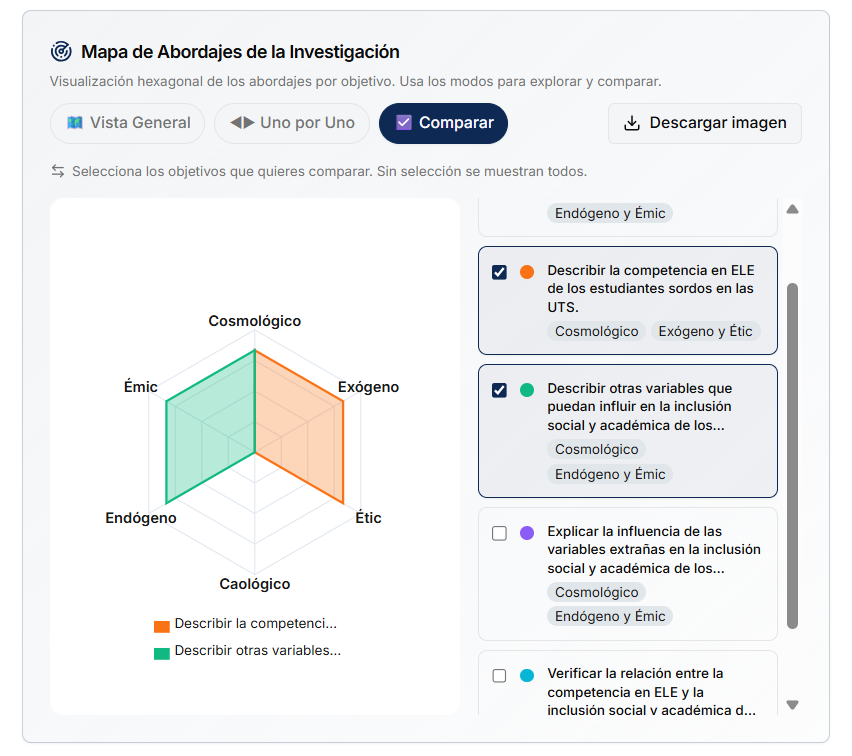
Suggested next step: Take your current specific objectives. For each one, answer the three questions: How much prior structure do I need? Who leads the process? From which perspective do I interpret? If the answers are not yet clear, that is exactly the work the approaches section in Tutoeris is designed to do.