5 min read
How to Justify or Defend Your Thesis Using Artificial Intelligence

You already have a research question, your holopraxic statement. You already have a destination, your objectives. Now comes the moment of truth: defending your idea before the world. Why does it matter? Why this topic? Why now?
Welcome to the art of justification. It is not a mere requirement; it is the engine of your thesis, the passionate and logical argument that gives your work life and purpose.
Today we are going to break down how to build a solid, compelling, and methodologically flawless justification. And the first thing is to understand its essence: the justification is the “why” behind your research (its engine), and it should not be confused with the “what for” (the objectives and purposes you hope to achieve).
Types of arguments for your justification
To build a solid defense, you need an arsenal of arguments. Your justification can rest on one or several of these powerful reasons:
- Needs or Gaps: You argue that your thesis is necessary because a problematic situation exists, something that is not working the way it should. Example: “We investigate the quality of learning because multiple studies reveal deficiencies in the current educational system.”
- Concerns or Curiosities: Your research is justified because there are unresolved questions, contradictions in previous studies, or a knowledge gap that no one has explored in that context or from that perspective.
- Motivations or Interests: The topic is of great interest to you, is valued by the scientific community, or is crucial for society. Be careful! This type of argument must always be supported by references to authors who validate that importance.
- Contradictions: You justify your study by pointing out a paradox or an evident clash between two realities. Example: “We investigate the quality of learning because, although global demands are rising, results in our region are deteriorating.”
- Potentialities: Your research is based on taking advantage of a characteristic or resource of the context that has not yet been tapped and that your study could help develop.
- Opportunities: You argue that it is the perfect moment to investigate because of favorable circumstances: a new policy, a technological advance, a sudden institutional interest, and so on.
What exactly should you justify?
A bulletproof justification not only defends the general idea but also every one of the decisions you made when formulating your holopraxic statement. Get ready to respond to this cross-examination:
- Why that topic? Of all the possible topics, why this one?
- Why those events of study? Within your topic, why do you focus on those specific variables or characteristics?
- Why those units of study? Why did you choose those people, groups, or objects for your thesis?
- Why that context? What makes that geographic, social, or cultural setting special or relevant?
- Why that temporal perspective? Why is it important to do it now or during that specific period?
- Why that theoretical approach? Why do you rely on that theory and not another?
- Why that level and holotype of research? Why is your study, for example, descriptive and not explanatory? What gap does that decision fill?
Tutoeris: Your Argument Matrix for a solid justification
Justifying each of these aspects can seem like a monumental task. This is where Tutoeris introduces one of its most powerful and useful tools: the Argument Matrix.
Once you have selected your holopraxic statement in the Project Hub, Tutoeris’s artificial intelligence does not leave you staring at a blank page. Instead, it breaks your question down into its key elements (topic, events of study, units of study, context, etc.) and creates a matrix, an organized table where, for each component, the AI generates initial arguments that support your choice.
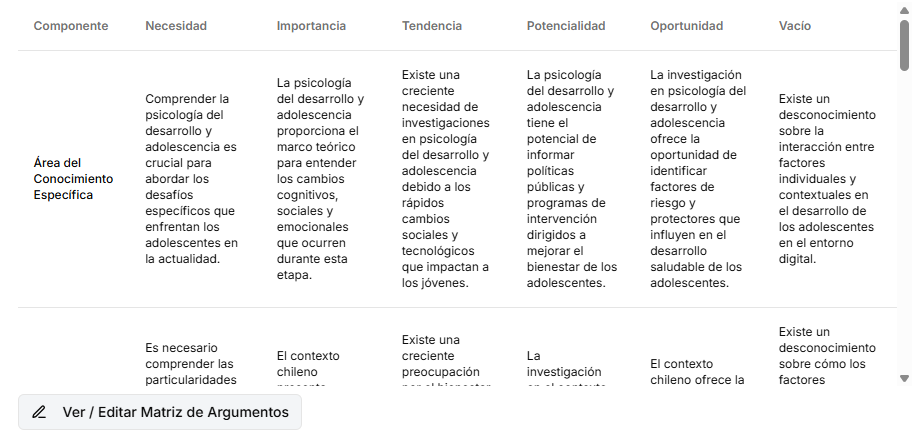
Imagine your research question is: “What are the characteristics of the perception of online competence, gaming time in video games, and self-esteem in adolescents aged 15 to 18 in Chile during the year 2025?”
Tutoeris’s Argument Matrix would present you with something like this:
- Component: Events of study (online competence, gaming time, self-esteem)
- AI-Generated Argument: “The interrelationship between the use of online platforms, gaming habits, and psychological health such as self-esteem is an area of growing academic and social concern, justifying a study that addresses them together.”
- Component: Units of study (adolescents aged 15 to 18)
- AI-Generated Argument: “Late adolescence is a critical stage for the consolidation of identity and self-esteem, and at the same time a period of maximum engagement with video games, which makes this population group especially relevant for the study.”
- Component: Context (Chile)
- AI-Generated Argument: “Chile has high rates of internet penetration and video game consumption in Latin America, yet few local studies analyze the specific impact of these activities on the self-esteem of its adolescents, justifying the need for contextualized research.”
- Component: Holotype (Descriptive)
- AI-Generated Argument: “Despite the general interest, there is a lack of basic descriptive data characterizing how these variables present themselves together in the Chilean population, so a descriptive study is a fundamental first step before advancing to explanatory or correlational research.”
This matrix does not hand you the final text. It gives you something far more valuable: a strategic starting point for each section of your justification. With these AI-generated arguments, your task as a researcher becomes clear and focused: to find the theoretical support, the data, and the author citations that back up each of these points.
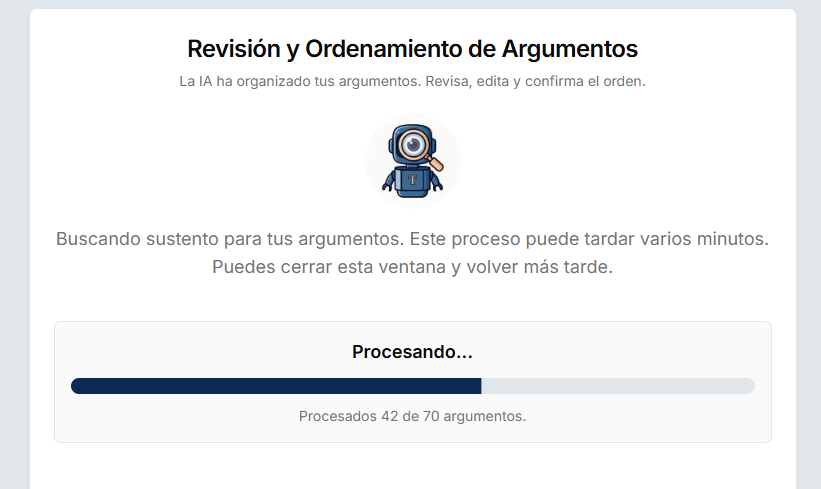
The result is an incredibly complete, well-structured, and robust justification section, where every methodological decision in your thesis is solidly defended.