4 min read
Avoid These Mistakes: How Do You Build Chapter 1 of Your Thesis?

If you have ever stared at a blank page when starting your thesis, you know that Chapter I can feel like a mountain to climb. Known as “The Problem” or “Contextualizing the Topic,” this chapter is much more than an introduction; it is the foundation on which your entire research project will be built. If the foundation is weak, the whole building is at risk.
Today we are going to demystify this chapter. First, we will walk you through its anatomy, pillar by pillar, according to research methodology. Then, we will show you how Tutoeris’s artificial intelligence guides you in building this foundation in a logical, coherent, and stress-free way.
Anatomy of Chapter I: the pillars of your thesis
It is essential to understand that the order of these pillars is the way they are presented in the final report for clear communication, even though the process of creating them is far more dynamic.
1. General description of the problem situation / contextualizing the topic
This is where you paint the big picture. You answer the overarching question: “About what?”. In this section, you describe in broad terms the phenomenon that caught your attention. You must make very clear the circumstances of time, place, and manner surrounding your topic, establishing the boundaries of your thesis.
2. Justification of the research
This pillar answers the “Why?” behind your study. The justification focuses on the needs, concerns, and motivations that led you to research this topic. It is not the place to talk about the future benefits or contributions of your study (those are “purposes”). Think of the justification as the fundamental reason, the spark that started it all.
3. Framing the holopraxic statement / research question
This is the heart of your project, the “seed of the research.” As we saw in previous posts, the holopraxic statement is that precise question that captures everything you want to know. It must be so clear that it indicates exactly what you want to learn, about which event of study, in whom, and in what context. The final version you present here is the result of deep reflection and of having configured your noological grounding (your theoretical framework).
4. Objectives of the research (general and specific)
Finally, this section answers the “For what purpose?” of your thesis.
- The General Objective: This is your final destination. It contains the holotype (the type of research) and the level of depth you will reach.
- The Specific Objectives: These are your road map, the stages or steps you must take to reach that destination.
Always remember: objectives are achievements, not activities. Never include verbs such as “to survey” or “to interview” in an objective!
How does Tutoeris’s artificial intelligence help you with Chapter 1?
Now that we know the pillars of Chapter I as they are presented, let’s look at how Tutoeris, with its artificial intelligence, helps you build them in the correct methodological order.
Within your Project Hub in Tutoeris, the process is a step-by-step guide that avoids chaos and ensures coherence.
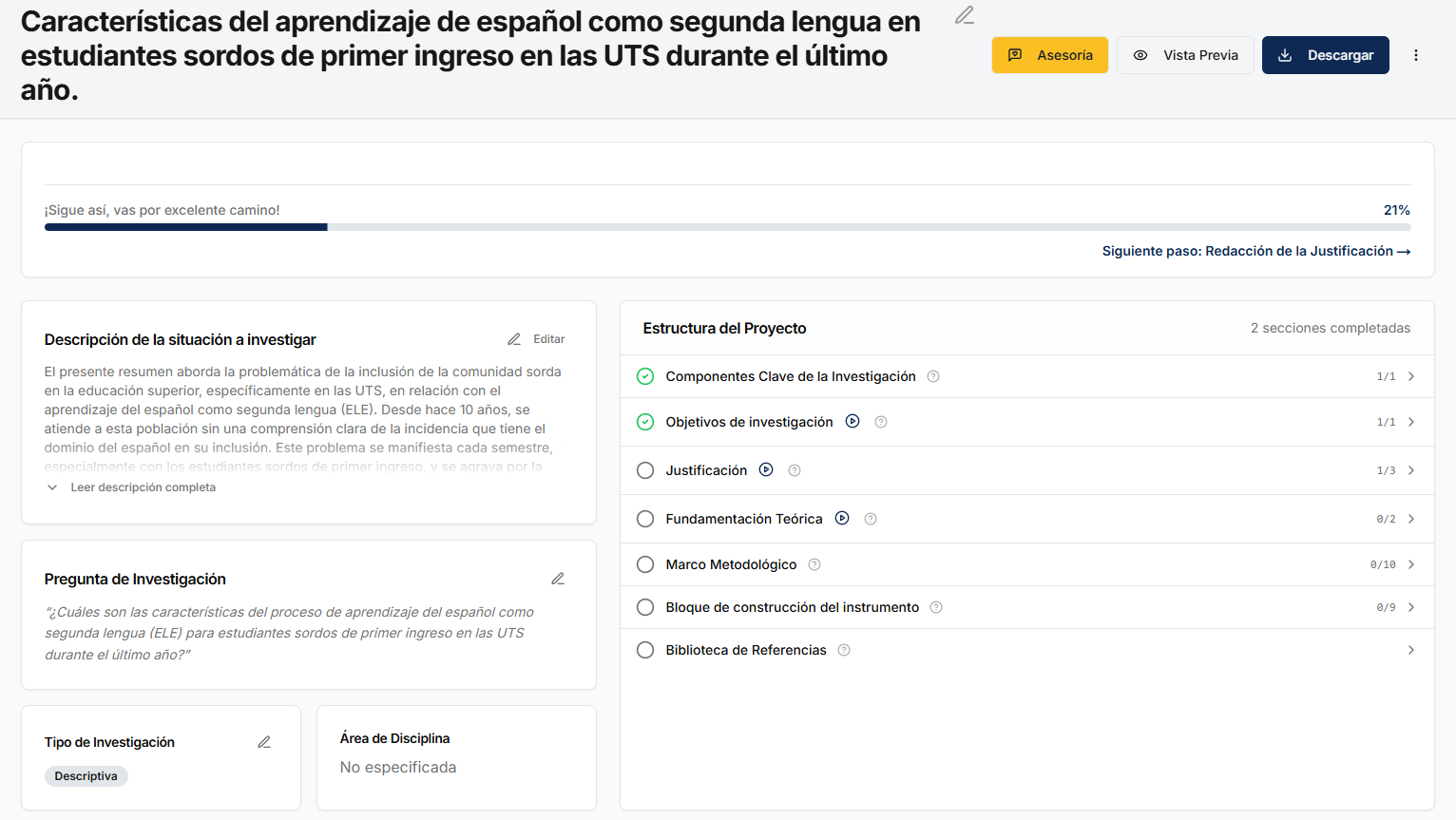
- Your Starting Point: The Description of the Situation. Your journey begins here. You tell Tutoeris about the topic you are passionate about, describing the general context.
- The Decisive Moment: Selecting the Holopraxic Statement. Tutoeris’s artificial intelligence analyzes your description and proposes several professional research questions. Next to each one, it shows you its holotype. The moment you choose one, you have defined the DNA of your entire thesis.
- Automated Coherence: Generating the Objectives. Like magic! Once you have selected your question, Tutoeris instantly generates the general objective and all the necessary specific objectives, guaranteeing perfect methodological alignment.
- Argumentation with Purpose: Building the Justification. Only now that you have a destination (objectives) and a map (question) does Tutoeris guide you in building your justification. You will argue from solid ground, defending a clear and well-defined project.
And the grand finale… once you have completed these steps in the Hub, with a single click on “Download (DOCX)”, Tutoeris assembles everything into a Word document, presenting the pillars in the formal order of Chapter I.
Stop seeing Chapter I as an obstacle and start seeing it as the first great victory on the path of your thesis. With clear guidance and a smart tool, you are ready to build something great.