4 min read
The Specific Objectives of Your Thesis: The Map for Your Thesis

In our previous conversations, we established the holopraxic statement as the “seed” and the general objective as the “compass” of your thesis. Today, we will chart the precise route of that journey. We will discuss the specific objectives: the detailed map, the successive milestones that ensure you reach your destination with success and methodological rigor.
What Are Specific Objectives?
If the general objective is the final destination, the specific objectives are the planned stops, the partial and successive achievements that, when reached in order, ensure that the main goal of your thesis is fulfilled.
Within the holistic understanding of research, these are not mere tasks. They indicate the stages that must be covered in order to attain the general objective. Think of them as the rungs of the holistic spiral: to reach a complex level of knowledge, you must first have secured the previous levels.
5 Requirements for a Flawless Formulation in Your Thesis
The correct formulation of the specific objectives is just as vital as that of the general objective. The coherence of your entire study depends on them.
- Correspondence with the general objective: Each specific objective must refer to an event of study contained within the general objective. If a specific objective introduces a new event, it most likely does not belong to that thesis.
- A single achievement per objective: Each specific objective must point to a single achievement. It is incorrect to formulate “to analyze and compare…”; these must be two separate objectives.
- Verbs and knowledge achievements: They must begin with an infinitive verb that represents a knowledge achievement, not a methodological activity. “Reviewing the literature” or “applying an instrument” are activities, not objectives. The product of an objective is reflected in the results; that of an activity, in the methodology.
- Appropriate level of complexity: The specific objectives should be of lower complexity than the general objective. However, the final specific objective should, as a rule, match the degree of complexity of the general one in order to close the process. It is a serious error to formulate a specific objective at a higher level than the general one.
- Do Not Include Techniques or Instruments: Never mention in the objective how you will do it. “To describe perceptions through surveys” is incorrect. The technique belongs in the methodology chapter.
Tutoeris: Building Your Methodological Roadmap
This is where the magic of Tutoeris, as an artificial intelligence assistant, transforms months of methodological planning into seconds of clarity. As you already know, once you choose your holopraxic statement and the holotype of your research, Tutoeris formulates the perfect general objective.
But it does not stop there. Tutoeris goes one step further and builds the complete scaffolding for your thesis: it automatically generates with AI all the specific objectives needed to attain your general objective.
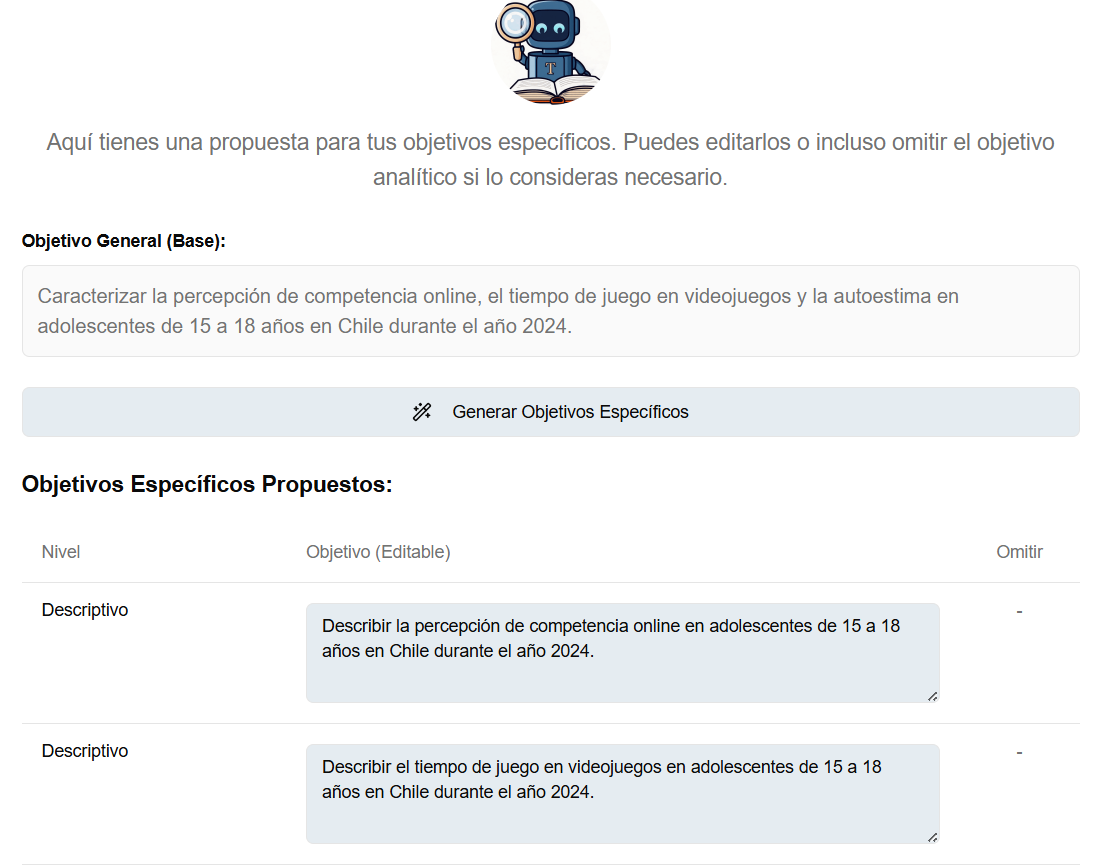
How does it do this? Tutoeris analyzes the holotype and the level of complexity of your general objective and, drawing on the logic of the holistic spiral, determines all the prior stages you need to investigate. It then formulates a methodologically flawless specific objective for each of those stages.
This is how Tutoeris gives you more than just a list. It delivers a complete research plan, ensuring that you cover all the necessary knowledge foundations so that your final proposal (the design of the program) is feasible, relevant, and successful. This is what has traditionally been visualized in a holopraxic table, now generated intelligently.
In addition, Tutoeris knows when a “leap between stages” is possible. If, while configuring your project, you indicate that a clear diagnosis of the problem already exists (and you cite it in your noological foundation), the tool can omit the descriptive objective and begin at a more advanced stage.
Crucial Clarification: Operationalization of Events, Not Objectives
It is essential to reiterate a key concept that is often confused: research objectives are not operationalized. They are achievements, not variables. What gets operationalized are the events of study (the variables). Operationalization is the process of bringing an abstract event (such as “academic performance”) to an observable plane so that it can be measured, but instruments are built to measure those events, not to measure the attainment of the objective itself.
In short, the formulation of specific objectives is a strategic act that charts the path of your thesis. By understanding their logic and their function, and with an ally like Tutoeris, you can transform an overwhelming methodological challenge into a clear and effective action plan toward the generation of knowledge.
References
Hurtado de Barrera, Jacqueline. (2012.). Metodología de la investigación. Guía para una comprensión holística de la ciencia. Cuarta edición. Bogotá, Colombia: Ediciones Quirón-Sypal.