5 min read
The General Objective: The Compass of Your Thesis

In our previous post, we discussed the “seed” of all research: the holopraxic statement. Today, we will take the next logical step and delve into the element that gives that seed direction and purpose: the general objective.
If there is a cardinal point that guides the entire journey of a thesis, this is it. Far from being a mere formality, the general objective is the compass that orients the inquiry process, defines the kind of knowledge being sought, and, ultimately, determines the success and significance of your study.
The fundamental purpose of your thesis
The general objective, in essence, is the expression of a purpose or aim, directed toward reaching a result, a goal, or a specific achievement. It represents the “what for” of the research, that toward which your thesis is aimed. It is the study’s point of arrival, indicating the level of complexity of the knowledge you aspire to build. A good thesis correlates directly with a properly formulated objective.
The key functions of the general objective
- Guidance and Orientation: The general objective specifies the aim of the research in its broadest expectations. It serves as a constant point of reference for the thesis writer. With a clear objective, you know exactly where your work is headed and the kind of knowledge you want to generate.
- Determining the Type of Research (Holotype): This is one of the most significant contributions of the holistic understanding of research. The general objective directly defines the holotype of research to be carried out. Unlike traditional epistemic models in which the method took precedence, in the holistic conception the method is subordinate to the objective. Thus, whether your thesis will be exploratory, descriptive, explanatory, projective, evaluative, and so on, is established according to the category of the objective you seek to achieve.
- Methodological Coherence: The clarity of the general objective is vital for selecting the methodological design, the events of study, the data collection techniques and instruments, and the type of data analysis. Without a precise objective, it is impossible to choose a suitable instrument. Here a key process comes into play: operationalization. When the events in your thesis are abstract (e.g., “organizational culture,” “emotional intelligence”), operationalization is the process of taking them from that abstract level to an empirical, observable plane, allowing you to measure them rigorously.
Requirements for a flawless formulation
For your thesis’s general objective to be effective, it must adhere to specific and rigorous criteria:
- A Single General Achievement: Your thesis must have a single general objective. Formulating multiple general objectives is a mistake that breeds imprecision and ambiguity, since it amounts to combining several investigations into one.
- Aimed at New Knowledge: It must be oriented toward obtaining novel knowledge, not toward activities such as learning or mere documentation. Methodological activities (e.g., “administering surveys”) are not research objectives.
- A Single, Coherent Verb: It must begin with a single infinitive verb that represents the desired level of depth. A simple change in the verb (e.g., from “describe” to “explain”) completely alters the holotype of the thesis.
- Clear, Concise, and Direct: The wording must be straightforward, free of ambiguity and literary flourishes. The complexity lies in the achievement, not in the words.
- Do Not Include Techniques or Instruments: Do not mention how you will do it (e.g., “through interviews…”) in the objective. That belongs to the methodological framework.
- Attainable and Distinct from Aims: The objective must be achievable through the completion of the thesis. It is essential to distinguish it from “aims,” which are longer-term aspirations that go beyond the scope of your study (e.g., “contributing to world peace”).
- Correspondence with the Research Question: The general objective must directly answer your holopraxic statement, maintaining the same level of knowledge.
Tutoeris to the rescue: from the question to the general objective with artificial intelligence
As we saw in our previous post, Tutoeris, together with artificial intelligence, helps you explore the potential of your idea by generating a range of holopraxic statements (questions), each one corresponding to a distinct holotype of research.
But we do not stop there. We understand that coherence is the key to a solid thesis.
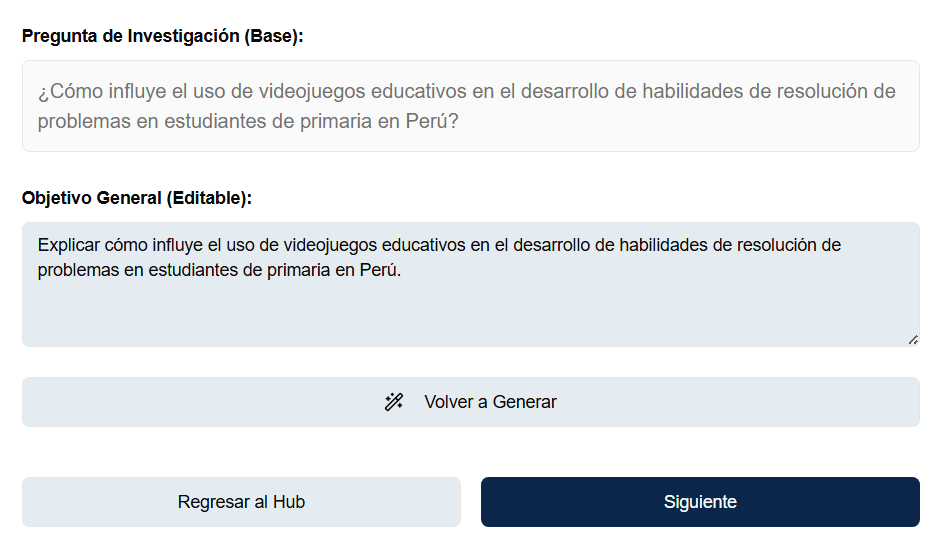
Once you select the holopraxic statement and the holotype that will guide your thesis, Tutoeris takes the next logical and crucial step: it automatically formulates the corresponding general objective.
This eliminates guesswork and guarantees perfect methodological alignment from the very beginning. The verb of the objective that Tutoeris generates will correspond exactly to the holotype you chose, and the rest of the statement will align with your research question.
Let’s see it with our earlier example about “low performance in mathematics”:
- If you choose the Explanatory Holotype:
- Your Holopraxic Statement (Question): “How do the teacher’s pedagogical strategies influence the development of mathematical anxiety…?”
- Your General Objective (Generated by Tutoeris): “Explain how the teacher’s pedagogical strategies influence the development of mathematical anxiety…”
- If you choose the Projective Holotype:
- Your Holopraxic Statement (Question): “What design of a peer tutoring program could be implemented to improve performance…?”
- Your General Objective (Generated by Tutoeris): “Design a peer tutoring program that makes it possible to improve performance…”
With this functionality, Tutoeris becomes your first methodological advisor, ensuring that the heart of your thesis (its objective) beats in perfect sync with its question.
References
- Hurtado de Barrera, Jacqueline. (2012.). Metodología de la investigación. Guía para una comprensión holística de la ciencia. Cuarta edición. Bogotá, Colombia: Ediciones Quirón-Sypal.