6 min read
The Holopraxic Statement: The Research Question with AI

Today we turn to the starting point of every rigorous project, the element that can determine the success or failure of our research or thesis: the question. Especially for those facing the challenge of a thesis, clarity from the outset is essential. Within the framework of the holistic understanding of science, we do not call this foundational element simply a “question,” but rather the “holopraxic statement.”
Understanding it is no mere academic exercise; it is the key to a thesis that is coherent, purposeful, and defensible.
What exactly is the holopraxic statement?
The “holopraxic statement” is defined as the phrase, question, or formulation that captures, in just a few words, what the researcher seeks to learn through the study or thesis being developed. Its power lies in its ability to state with total clarity “exactly what is to be known, about which event, in which units of study, and within what context.”
This is not a term chosen at random. It is called “holopraxic” because, quite literally, it “contains and guides the entirety of the research praxis.” It is, as the experts describe it, the “seed of the research.”
Consider it through this powerful metaphor: the holopraxic statement is a “seed.” Just as a seed contains all the genetic information needed for a living being to develop, the holopraxic statement contains everything needed to guide the research—and, by extension, the thesis—from beginning to end. It is this statement that “opens the research, orients the methods, guides the procedures, and on that basis the conclusions are reached.”
Keys to “powering up” the seed of your thesis
For the seed of your thesis to germinate and bear fruit, it must be cultivated with precision. “Unlocking” its potential means adhering to very specific formulation criteria. Here are the keys:
- Precision and Delimitation: The statement must be “condensed, brief, and concrete,” as well as “precise and clear.” It must answer unambiguously: What you want to know, about which characteristic, in whom, in what context or situation, and when.
- Singularity and Relevance: There must be “a single holopraxic statement” per piece of research or thesis. It should point to a “novel topic or aspect” and, fundamentally, be “researchable.”
- Grounding in Exploration and Noological Foundation: Pay close attention here. A fatal mistake is to formulate the definitive question of the thesis without prior grounding. The holopraxic statement begins as a “first approximation,” but “it is formulated in definitive terms only once a more complete literature review has been carried out and the noological foundation has been established.” This foundation, which is the construction of your thesis’s theoretical underpinning, ensures that the terms you use are the appropriate ones.
- Coherence with the Research Holotype: The holopraxic statement must “reveal the research holotype” (the type of research). This will define your thesis’s methodology. For example:
- A question such as “What is the most efficient way to build…?” leads to projective research.
- One such as “What makes a teacher successful?” leads to explanatory research.
- Avoiding Methodological Activities as Outcomes: Your statement must point to a knowledge outcome, not to a task within the process. The goal of your thesis is not “to administer a survey,” but rather “to understand the perception of….”
Artificial Intelligence: The Catalyst for Your Thesis
The process of meeting these criteria—especially building the noological foundation—has traditionally been the most laborious stage of writing a thesis. It involves “gathering the information, selecting the relevant material, eliminating material that is too general, and the writing itself.”
This is where Artificial Intelligence (AI) becomes an unprecedented ally for the modern researcher or thesis writer. AI can:
- Accelerate the Noological Foundation: Analyze thousands of documents to identify theories and knowledge gaps, allowing you to build a solid theoretical framework for your thesis in a fraction of the time.
- Assist with Precision and Delimitation: Help you refine a general idea by suggesting variables, populations, and contexts so that your statement meets the criteria of clarity and concreteness that a thesis committee demands.
- Verify Novelty: Conduct exhaustive searches to ensure that your formulation is novel and adds real value to the field of study.
Tutoeris: The Holistic Understanding Applied to Your Thesis
At Tutoeris, we have operationalized these principles of the holistic understanding of research. Our platform is a tool powered by methodological artificial intelligence, designed to guide you in formulating a robust, coherent holopraxic statement for your thesis.
We understand that the hardest step is connecting an initial idea with a specific research holotype. And that is precisely where we empower you.
One problem, multiple holotypes: choose the path of your thesis
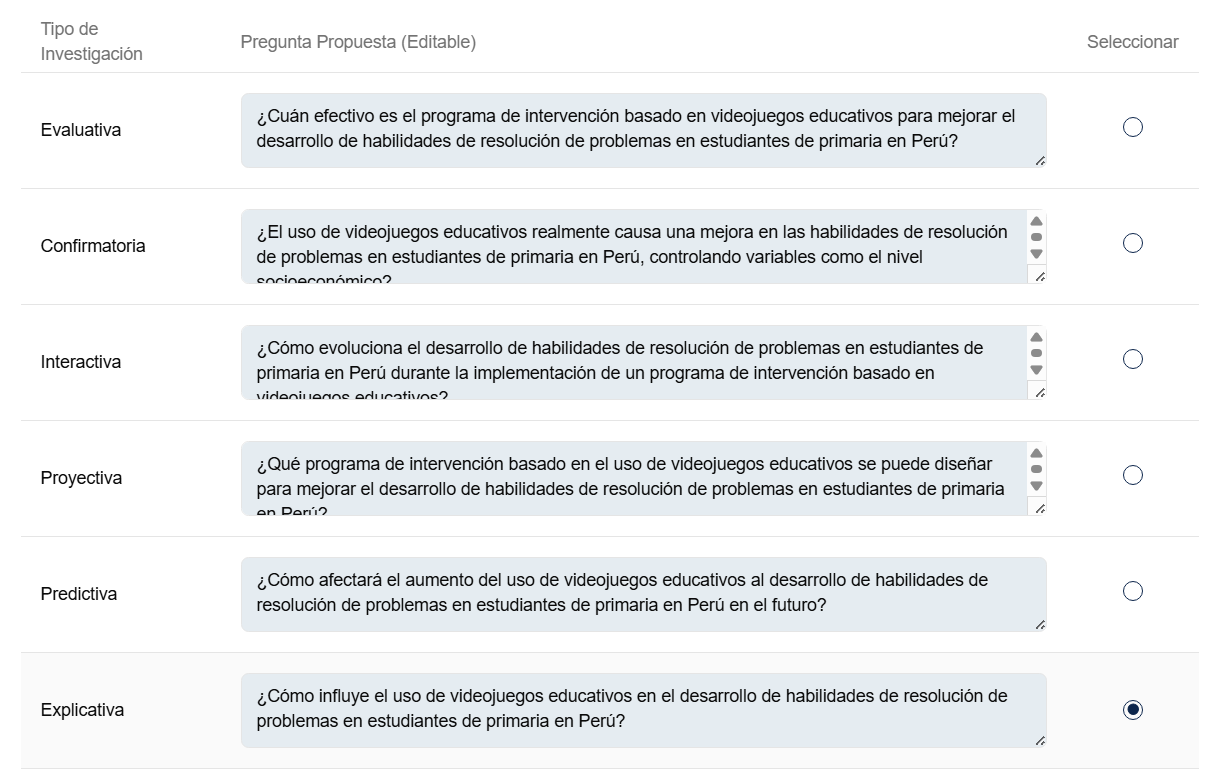
Through its artificial intelligence, Tutoeris offers you different types of research so you can select the one best suited to your thesis.
You present Tutoeris with your idea or research problem—for example: “Student dropout in higher education.”
Our artificial intelligence (AI), trained in these concepts, will present you with a spectrum of holopraxic statements, each formulated to correspond to a distinct research holotype. This clarity is essential for defining the scope and methodology of your thesis.
- Exploratory Holotype: What are the experiences and meanings that students who left their university studies attribute to their decision?
- Descriptive Holotype: What is the dropout rate and the sociodemographic profile of the students who drop out at University Z during the 2024–2025 period?
- Comparative Holotype: Are there differences in the risk factors associated with dropout between students in the sciences and those in the humanities?
- Correlational Holotype: What relationship exists between a student’s level of social integration into university life and the likelihood of dropping out?
- Explanatory Holotype: In what way does the family’s economic situation act as a determining cause of university student dropout?
- Projective Holotype: What guidelines should a student support program contain in order to prevent dropout among first-year students?
- Evaluative Holotype: What was the level of effectiveness of the “Permanence” scholarship program in reducing student dropout at University Y?
This approach allows you to visualize all the possible paths for your thesis. You can then make an informed decision and select the research holotype that aligns perfectly with your objectives and academic requirements.
Your research praxis, and the success of your thesis, deserve to start off on the right foot. The holopraxic statement is your map. With the right tools, you can ensure that your thesis points in the right direction from day one.
References
- Hurtado de Barrera, Jacqueline. (2012.). Metodología de la investigación. Guía para una comprensión holística de la ciencia. Cuarta edición. Bogotá, Colombia: Ediciones Quirón-Sypal.